Adult Loneliness: Why Connection Feels Harder to Find, How Friendships Change, and Ways to Reconnect

Feeling Lonely Doesn't Mean You're Alone
Many people are surprised by how lonely adulthood can feel. From the outside, life may appear full.
You have a career.
A partner.
Children.
Coworkers.
Neighbors.
A calendar packed with responsibilities.
Yet despite being surrounded by people, something feels missing. You may find yourself longing for deeper conversations or feeling disconnected after social gatherings. Missing friendships that once felt effortless and wondering why connection seems harder than it used to. If this sounds familiar, you're not alone.
Loneliness has become so widespread that in 2023, the U.S. Surgeon General identified it as a significant public health concern. Research suggests that many adults experience loneliness at some point in their lives, regardless of age, relationship status, career success, or social activity. And perhaps most importantly: Loneliness is not a personal failure, it’s a human experience.
What Loneliness Actually Is
Many people think loneliness means being alone but in reality, loneliness and solitude are not the same thing. A person can spend time alone and feel deeply content. Likewise, someone can be surrounded by family, coworkers, friends, or even a romantic partner and still feel profoundly lonely. Loneliness is less about the number of people in your life and more about the quality of connection you experience. Researchers often define loneliness as the gap between the social connection we desire and the connection we actually experience. In other words: loneliness occurs when we don't feel meaningfully seen, understood, valued, or connected.
Why Adult Friendships Feel Different Than They Used To
One of the most common contributors to adult loneliness is the changing nature of friendship. As children, teenagers, and young adults, friendship often develops naturally. We spend hours together in school, share classes, sports, activities, and routines. Proximity creates connection but as we grow older, our social circles change. Psychologists refer to this as the "mere exposure effect" — the tendency for relationships to develop through repeated contact and shared experiences.
As adults, those built-in opportunities often disappear. Instead, life becomes filled with:
Careers
Parenting responsibilities
Caregiving roles
Household management
Relocations
Relationship commitments
Friendship becomes something we must intentionally create and maintain. And intentional connection often requires energy that many people feel they no longer have.
The Hidden Grief of Changing Friendships
Many adults quietly grieve friendships. Not because of conflict or betrayal, but because life changes. Friends move away, schedules stop aligning. Priorities shift and people grow in different directions. One of the challenges of friendship loss is that society rarely recognizes it as grief. When a romantic relationship ends, people understand. When a loved one dies, support often follows. When a friendship slowly fades, there is often no acknowledgment of the loss. Yet friendship grief can be deeply painful.
You may find yourself missing:
Shared experiences
Inside jokes
Emotional support
A sense of belonging
A version of yourself that existed within that relationship
Many adults carry this grief without realizing that's what they're experiencing.
Why Loneliness Affects More Than Our Social Lives
Humans are fundamentally wired for connection. Attachment theory suggests that close relationships play an important role in helping us feel safe, supported, and emotionally regulated. Connection isn't simply a social luxury, it's part of how our nervous systems function. Research has linked chronic loneliness with:
Increased anxiety
Depression
Poor sleep quality
Higher stress levels
Reduced overall wellbeing
Increased risk for cardiovascular disease
While loneliness itself is not a mental health diagnosis, its impact on emotional and physical health is significant. The nervous system often interprets social disconnection as a form of threat and this is one reason loneliness can feel so painful.
The Impact of Loneliness on Your Sense of Self
One of the lesser-discussed consequences of loneliness is its effect on identity. Healthy relationships often act as mirrors — they help us feel seen, understood, valued and known. Without meaningful connection, people may begin questioning:
Who am I?
Where do I belong?
Does anyone truly know me?
Am I important to others?
Over time, loneliness can influence self-esteem, confidence, and our sense of worth. Many individuals begin withdrawing further because loneliness often creates self-protective thoughts such as:
"Nobody wants to hear from me."
"I'm bothering people."
"Everyone else already has close friends."
"I'm the only one struggling with this."
These thoughts are understandable. Unfortunately, they often reinforce isolation rather than reduce it.
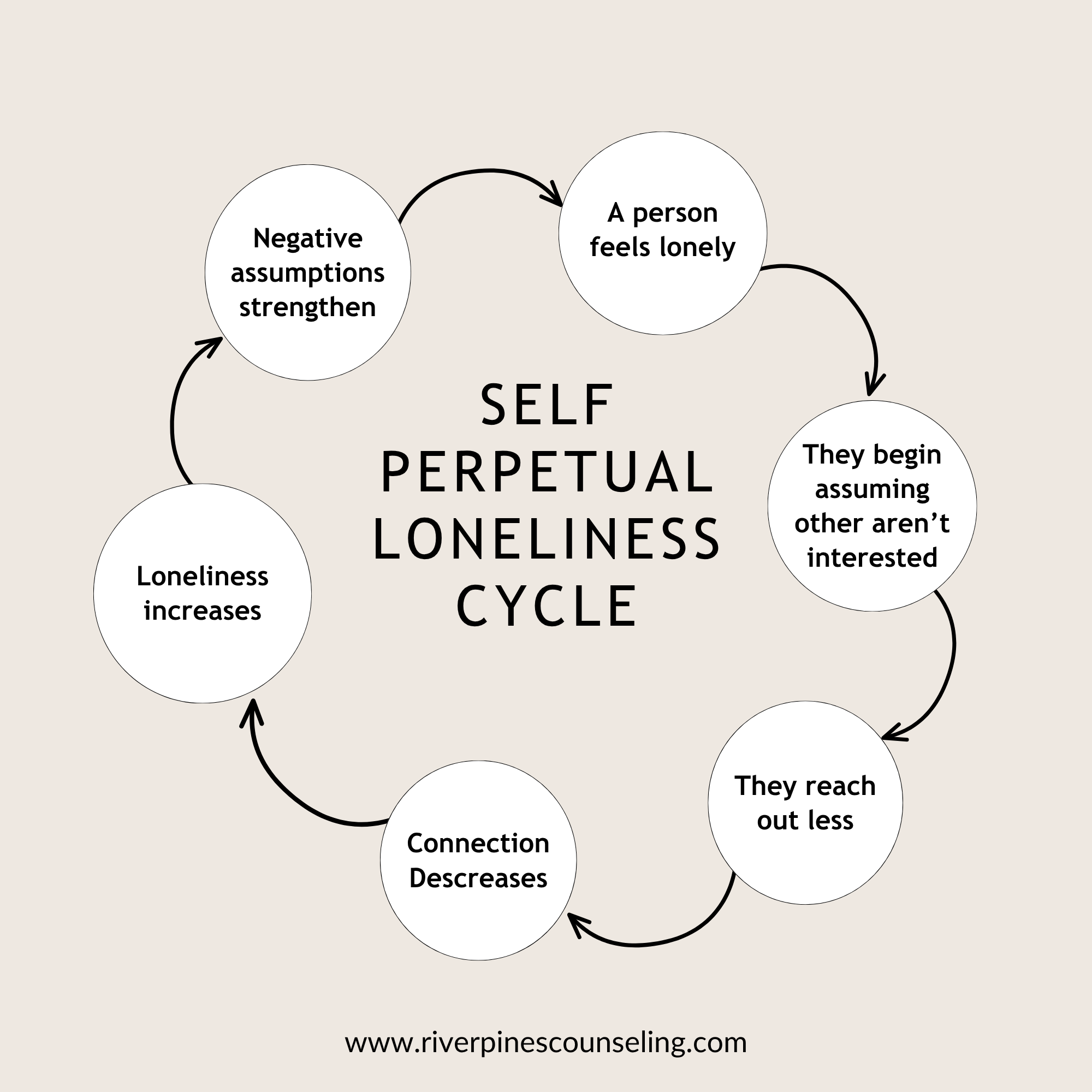
The Loneliness Cycle
From a cognitive behavioral therapy (CBT) perspective, loneliness can become self-perpetuating.
A person feels lonely.
↓
They begin assuming others aren't interested.
↓
They reach out less.
↓
Connection decreases.
↓
Loneliness increases.
↓
Negative assumptions strengthen.
This cycle can continue even when opportunities for connection exist. One goal of therapy is helping people identify and interrupt these patterns.
How Modern Life Contributes to Loneliness
While loneliness has always existed, several modern factors may intensify it.
Increased Mobility
People move more frequently for education, careers, and relationships.
Busy Schedules
Work demands often leave little energy for social connection.
Digital Communication
Technology helps us stay informed about others' lives but does not always create genuine connection.
Social Comparison
Social media can create the illusion that everyone else has thriving friendships and fulfilling social lives.
Reduced Community Spaces
Many adults have fewer opportunities to engage in meaningful, recurring community interactions than previous generations.
These factors don't cause loneliness by themselves, but they can make connection more difficult to cultivate.
Practical Ways to Navigate Loneliness
There is no quick fix for loneliness. However, there are meaningful steps that can help.
1. Normalize the Experience
Loneliness is part of being human — experiencing loneliness does not mean there is something wrong with you. Often, it means there is a need for deeper connection.
2. Focus on Depth Over Quantity
Many people assume they need more friends but often what they truly need is more meaningful connection. One authentic relationship can have a greater impact than dozens of casual acquaintances.
3. Initiate More Than Feels Comfortable
Many adults are waiting for someone else to reach out but connection often requires taking small risks. Send the text, make the invitation, schedule the coffee — you may discover others are feeling similarly disconnected.
4. Invest in Shared Experiences
Connection tends to develop through repeated interaction. Consider volunteer opportunities, community organizations, classes or recreation groups, faith communities or professional organizations. Relationships ofter grow naturally when people consistently share experiences.
5. Reconnect With Yourself
Sometimes loneliness is not only about disconnection from others but a reflection of our own disconnection from ourselves. Ask yourself:
What feels meaningful to me?
What energizes me?
What values matter most right now?
A stronger connection with yourself often supports stronger connections with others.
6. Practice Self-Compassion
Research by Dr. Kristin Neff and others suggests self-compassion is associated with greater emotional resilience and wellbeing. Rather than criticizing yourself for feeling lonely, try responding with curiosity and kindness.
How Therapy Can Help
Many people come to therapy because of anxiety, stress, burnout, relationship challenges, or life transitions. Along the way, they discover loneliness sitting underneath many of those experiences.
Therapy provides space to explore:
Friendship changes
Relationship patterns
Attachment styles
Self-worth
Social anxiety
Life transitions
Emotional disconnection
Grief related to changing relationships
Therapy cannot create friendships for you. What it can do is help remove barriers that may be interfering with meaningful connection.
Friendship and Connection in the Twin Cities and Stillwater Area
The Twin Cities metro and Stillwater communities offer tremendous opportunities for work, family life, and recreation.
At the same time, many professionals, parents, caregivers, and community members find themselves balancing demanding schedules with limited time for meaningful connection. It's increasingly common to meet successful, capable adults who quietly describe themselves as lonely. Not because they lack people in their lives, but because they miss feeling deeply connected.
Remember, loneliness is not a reflection of your worth. It is not evidence that you've failed socially and it is not something experienced only by people who are isolated. Many adults are navigating friendship changes, life transitions, demanding schedules, and evolving identities. Meaningful connection often requires more intentionality than it once did. But connection remains possible. Sometimes it begins with reaching out or with slowing down. And sometimes it begins with acknowledging that loneliness is present rather than pretending it isn't.
At River Pines Counseling, we help individuals navigate life transitions, anxiety, relationship challenges, grief, burnout, and emotional wellbeing. If loneliness, disconnection, or changing relationships have been weighing on you, therapy can provide a space to better understand your experience and reconnect with what matters most.
Research Sources for Publication
U.S. Surgeon General. Our Epidemic of Loneliness and Isolation (2023)
Holt-Lunstad, J., Smith, T.B., & Layton, J.B. (2010). Social Relationships and Mortality Risk. PLOS Medicine
National Academies of Sciences, Engineering, and Medicine. Social Isolation and Loneliness in Older Adults (2020)
Cacioppo, J.T. & Cacioppo, S. Research on loneliness and social neuroscience
Bowlby, J. Attachment Theory
Neff, K. Self-Compassion Research