Emotional Intelligence in Leadership: CliftonStrengths & EQ-i 2.0 Guide

Emotional intelligence (EI) is more than a professional skill – it’s a foundation for healthier relationships, clearer communication, and steadier decision-making. Whether you’re navigating a career transition, leading a team, or striving for personal growth, developing EI helps you respond to challenges with clarity rather than reactivity.
Two well-established frameworks are especially useful for gaining this insight: the CliftonStrengths 34 assessment and the EQ-i 2.0. Together, they offer a powerful look into how you naturally operate and how effectively you manage the emotional landscape of your life and work.
Why Emotional Intelligence Matters
Emotional intelligence refers to our ability to understand and manage emotions – both our own and others’. High EI is linked to:
Better mental health and lower stress
More effective leadership and team performance
Higher job satisfaction and reduced burnout
Stronger relationships and communication
Research shows that emotional intelligence accounts for roughly 58% of job performance in professional roles and is the strongest predictor of leadership success (Bradberry & Greaves, 2009). In mental health contexts, higher EI correlates with improved resilience, coping skills, and relationship satisfaction.
Part 1: CliftonStrengths 34 – Understanding Your Natural Talent Themes
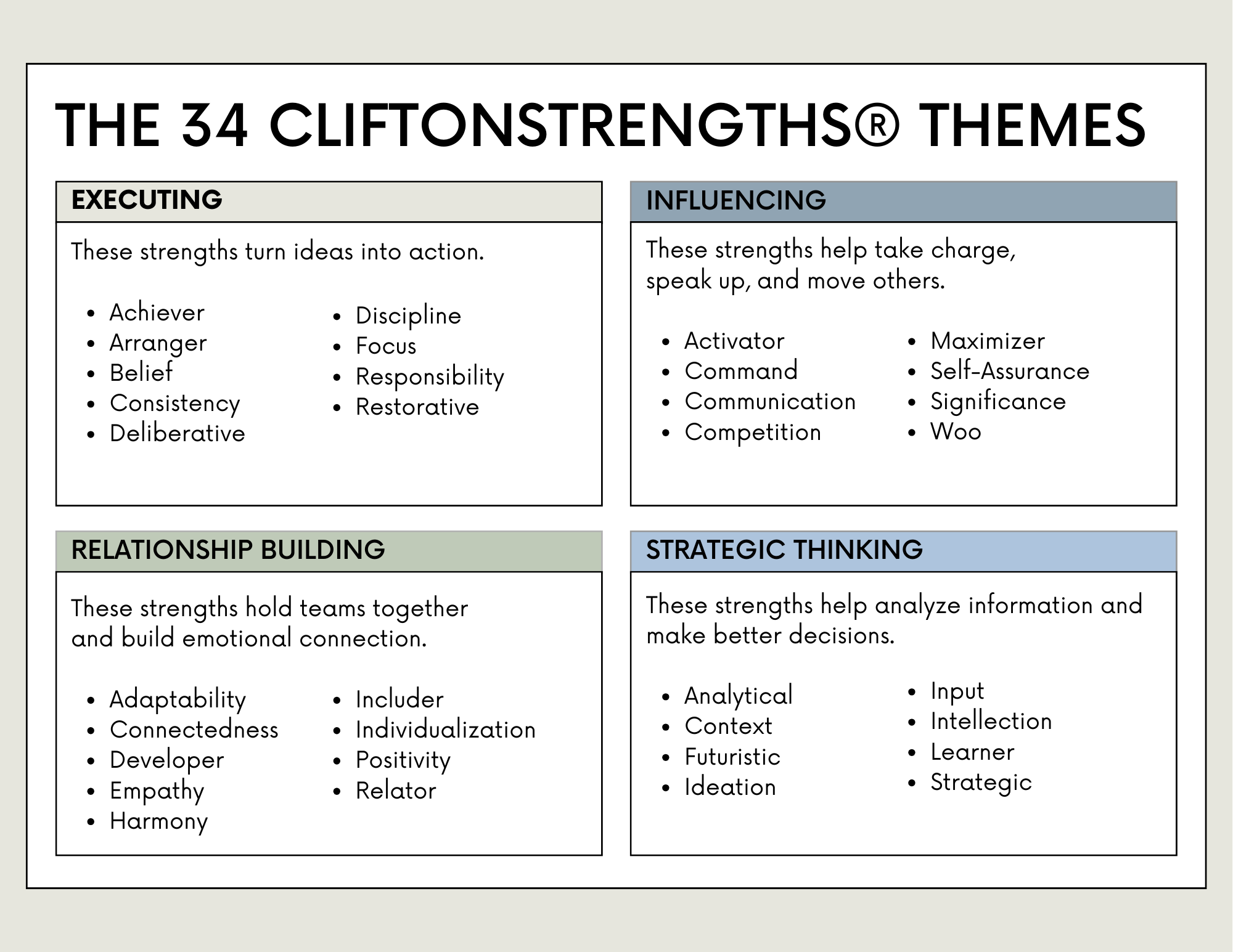
The CliftonStrengths 34 report (formerly StrengthsFinder) identifies your top natural talent themes across 4 domains:
Executing
Influencing
Relationship Building
Strategic Thinking
Rather than focusing on deficits, this model highlights what you naturally do well – the internal operating system that guides how you think, make decisions, and interact with the world.
How CliftonStrengths Enhances Emotional Intelligence
While CliftonStrengths is not an EI assessment, it provides complementary insight:
Self-awareness: Understanding your top strengths clarifies why you react the way you do, what motivates you, and where you may feel drained.
Relationship awareness: The report outlines how your strengths impact collaboration and communication.
Potential blind spots: Each strength can become overused under stress; identifying this helps reduce emotional reactivity.
Leadership development: Leaders who leverage strengths-based approaches increase engagement and reduce turnover.
Examples of Strength Themes and EI Connections
Empathy (Relationship Building) - Strong intuitive understanding of others’ emotions; helpful in counseling, leadership, and caregiving roles.
Command (Influencing) - Comfortable taking charge – valuable in crisis situations when tempered with emotional regulation.
Responsibility (Executing) - Deep commitment to follow-through; may need boundaries to reduce overwhelm or burnout.
Strategic (Strategic Thinking) - Sees patterns and possibilities; enhances long-term planning when coupled with collaboration skills.
CliftonStrengths gives language to who you are, which lays the groundwork for EI development.
Part 2: EQ-i 2.0 – Measuring Emotional Intelligence Competencies
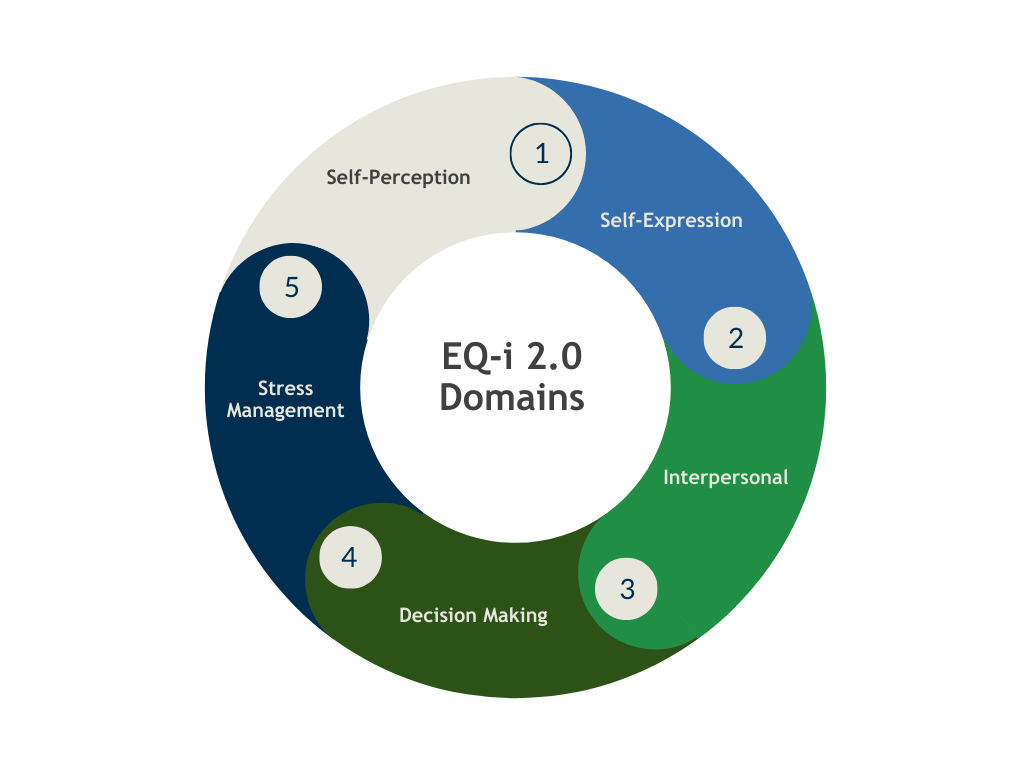
The EQ-i 2.0 is one of the most researched and validated emotional intelligence assessments available. It measures 15 subscales across 5 EI areas:
Self-Perception (self-regard, self-actualization, emotional self-awareness)
Self-Expression (assertiveness, independence, emotional expression)
Interpersonal (empathy, social responsibility, interpersonal relationships)
Decision Making (problem solving, reality testing, impulse control)
Stress Management (flexibility, stress tolerance, optimism)
What EQ-i 2.0 Reveals
Unlike CliftonStrengths, which identifies innate talent, the EQ-i 2.0 measures behavioral skills – how effectively you recognize, express, and regulate emotions.
It answers questions such as:
How well do I cope under pressure?
How do I express how I feel?
Do I listen deeply and empathically?
Am I making decisions clouded by emotion?
How do I show up in relationships?
Where do I need support, coaching, or skill development?
EI and Leadership Outcomes
Studies show leaders with higher emotional intelligence have:
Higher employee engagement
Better conflict resolution skills
Improved resilience and wellbeing
More collaborative teams
In fact, 90% of top-performing leaders score high in emotional intelligence (Goleman, 2011).
How the Two Tools Work Together
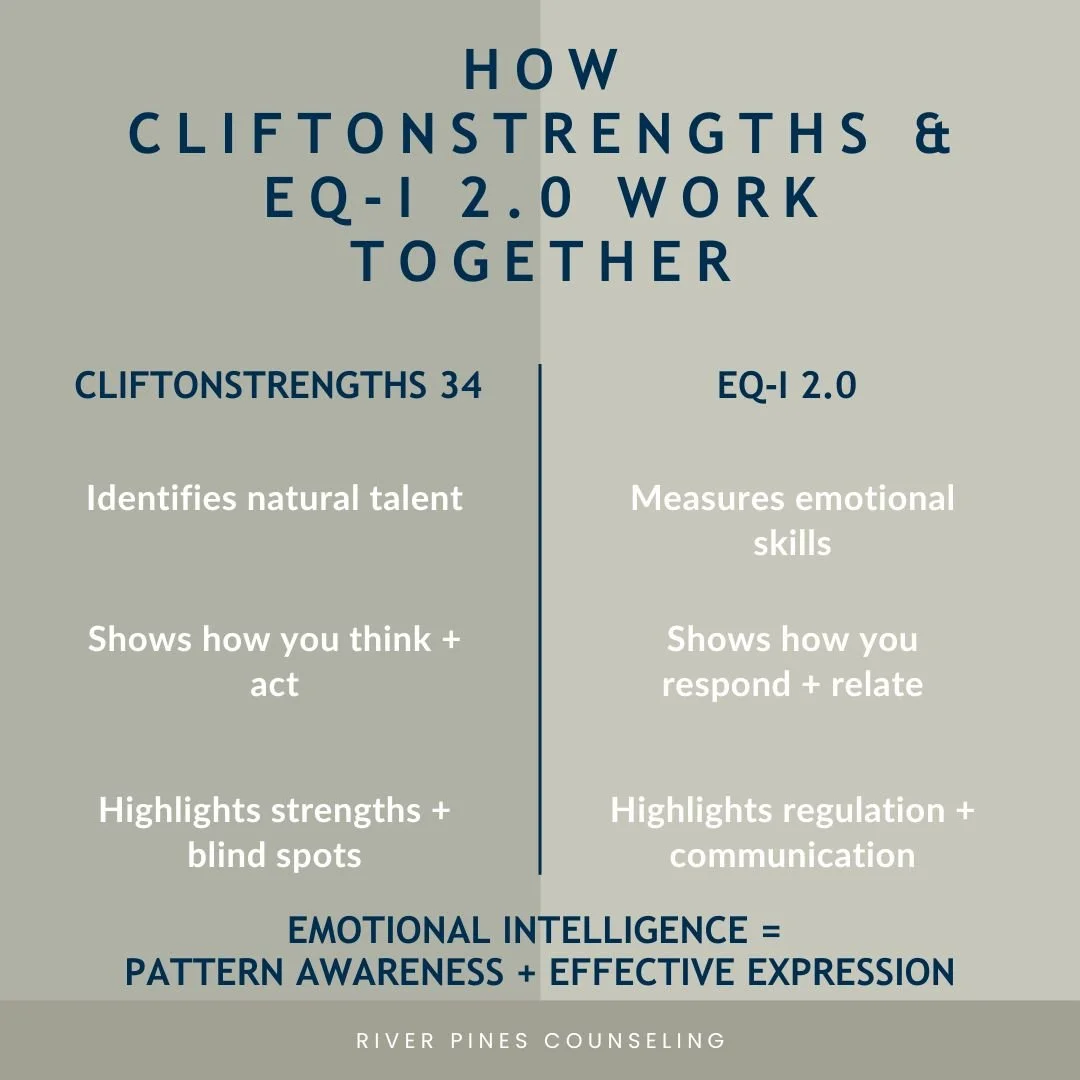
When CliftonStrengths 34 and EQ-i 2.0 are used together, they create a 360° picture of both who you are and how you relate to the world.
CliftonStrengths answers:
“What are my natural patterns?”
EQ-i 2.0 answers:
“How effectively am I using them?”
For example:
A leader with Empathy (Strength) and high Emotional Expression (EI) may excel at building trust.
A leader with Achiever (Strength) but low Stress Tolerance (EI) may push themselves into burnout.
Someone with Strategic (Strength) and high Reality Testing (EI) may thrive in complex problem-solving roles.
Someone high in Command (Strength) but low Impulse Control (EI) may unintentionally create tension.
Together, the assessments allow individuals to:
Build awareness of emotional triggers
Strengthen communication and decision-making
Reduce conflict and increase collaboration
Improve coping strategies and burnout prevention
Align leadership style with their natural strengths
Create actionable development goals
This pairing is especially powerful in leadership coaching, healthcare environments, first responders, education, and mental health support.
Using Emotional Intelligence for Personal & Professional Growth
Whether you are navigating a life transition, stepping into a new leadership role, or simply working toward healthier relationships, developing emotional intelligence can be transformative.
Therapy and executive coaching provide supportive environments to:
Process emotional patterns shaped by past experiences
Identify unhelpful narratives or blind spots
Learn emotional regulation and communication skills
Strengthen empathy, boundaries, and self-trust
Build confidence and resilience through challenges
Emotional intelligence is not fixed – it can be strengthened through intentional practice, self-reflection, and supportive guidance.
Final Thoughts
CliftonStrengths reveals your inner wiring.
EQ-i 2.0 reveals how effectively that wiring is functioning.
Emotional intelligence helps you bring both into alignment.
When you understand who you are, how you operate, and how your emotions shape your relationships and decisions, you gain powerful tools for a more grounded, effective, and fulfilling life.
If you or your organization would benefit from an integrated EI and strengths-based approach, our team is here to support you.
Sources
Bradberry, T., & Greaves, J. (2009). Emotional Intelligence 2.0. TalentSmart.
Goleman, D. (2011). Leadership: The Power of Emotional Intelligence. More Than Sound.
Mayer, J. D., Salovey, P., & Caruso, D. R. (2008). Emotional intelligence: New ability or eclectic traits? American Psychologist.
Harms, P. D., & Credé, M. (2010). Emotional intelligence and transformational leadership: A meta-analysis. Journal of Leadership & Organizational Studies.
Gallup Organization (2023). CliftonStrengths Technical Report and Overview.

Provider Spotlight: Darcy Stivland, LICSW, MA
Executive & Healthcare Provider Coach | Emotional Intelligence Specialist
Emotional intelligence isn’t just something Darcy teaches – it’s the foundation of how she partners with leaders, healthcare providers, and high-performing professionals. With over 20 years of clinical and leadership experience, Darcy brings a grounded, strengths-based approach to helping clients understand how they are wired (CliftonStrengths) and how they operate under pressure (EQ-i 2.0).
Darcy is certified in physician, executive, and wellness coaching and has extensive experience supporting professionals navigating burnout, role transitions, complex team dynamics, and high-stakes decision-making. She integrates evidence-based emotional intelligence coaching with personalized development plans to help clients lead with clarity, confidence, and compassion.
How Darcy Uses CliftonStrengths & EQ-i 2.0 in Coaching
Darcy combines both assessments to give clients a 360° understanding of their strengths and emotional functioning:
CliftonStrengths 34 helps clients identify their natural patterns – how they think, relate, and execute.
EQ-i 2.0 measures the emotional intelligence skills that influence leadership, communication, and resilience.
Together, these tools help clients:
Build awareness of stress triggers and emotional patterns
Improve decision-making and communication
Reduce burnout and develop sustainable leadership habits
Strengthen boundary-setting and team relationships
Navigate transitions with greater confidence and purpose
Darcy’s coaching style is affirming, strategic, and deeply human. Clients describe her as someone who “sees the whole picture,” helping them stay grounded while developing new capabilities.
Who Darcy Works With
Darcy partners with:
Physicians, nurses, and healthcare teams
Executives, directors, and entrepreneurs
First responders and high-stress professionals
Leaders navigating burnout or organizational change
Individuals seeking clarity in life transitions
Her work integrates emotional intelligence, leadership development, wellness practices, and real-time problem solving.
Why Clients Choose Darcy
Darcy’s combination of clinical expertise, leadership training, and compassionate coaching creates a safe space for clients to grow. She helps professionals build emotional agility, strengthen their leadership identity, and move toward a more aligned, resilient version of themselves.
If you’re interested in developing your emotional intelligence or want to explore coaching with Darcy, our team would be honored to support you.